GLP-1 receptor agonist
Semaglutide: the research picture
The most-studied GLP-1 analogue in the literature.
What is Semaglutide?
Semaglutide is a synthetic analogue of human glucagon-like peptide-1 (GLP-1), a 31-amino-acid incretin hormone released from intestinal L-cells in response to nutrient intake. Native GLP-1 is destroyed within about two minutes by the enzyme dipeptidyl peptidase-4 (DPP-4), which makes it useless as a research tool in its unmodified form. Semaglutide exists to solve that problem.
Three modifications do the work. An alanine-to-α-aminoisobutyric-acid substitution at position 8 blocks the DPP-4 cleavage site. A lysine substitution at position 34 removes an unwanted acylation site. And a C18 fatty-diacid chain attached via a short spacer at position 26 gives reversible albumin binding, slowing renal clearance dramatically. The result is a molecule with a half-life of roughly seven days instead of two minutes, a four-thousand-fold extension.
That stability is why semaglutide has become the reference GLP-1 agonist across the research literature. It is the compound against which newer incretin molecules: tirzepatide, retatrutide and others: are benchmarked, and it has the largest published dataset of any peptide in the class, including large cardiovascular outcome trials.
Our semaglutide is supplied lyophilised, independently assayed by HPLC and mass spectrometry to ≥99% purity, with a certificate of analysis tied to the lot on the vial. Supplied for laboratory research use only.
Why it's studied
The benchmark molecule
If you are characterising a new incretin compound, semaglutide is the comparator the literature expects. Its pharmacology, exposure profile and endpoint behaviour are documented in more peer-reviewed work than any other peptide in the class.
Single-receptor clarity
Because semaglutide engages GLP-1 and nothing else, it isolates that pathway cleanly. Dual and triple agonists are more powerful tools but they confound attribution, for mechanistic work on GLP-1 signalling specifically, a single agonist is the cleaner instrument.
Central and peripheral actions
GLP-1 receptors are expressed both on pancreatic beta cells and in central nervous system regions involved in appetite regulation. That dual distribution is a substantial area of study in itself, the peripheral and central arms of GLP-1 signalling are investigated as partly separable effects.
Long, flat exposure
A seven-day half-life produces near-steady-state concentrations in model systems on a weekly interval, which removes peak-trough variation as a confound in longer study designs.
How Semaglutide is understood to work
Receptor binding
Semaglutide binds the GLP-1 receptor, a class-B G-protein-coupled receptor, activating adenylate cyclase and raising intracellular cyclic AMP. In pancreatic beta cells this pathway is studied for glucose-dependent insulin secretion. The "glucose-dependent" qualifier matters, because it is the mechanistic reason GLP-1 agonism behaves differently from insulin itself in the literature.
DPP-4 resistance
The Aib8 substitution sterically blocks dipeptidyl peptidase-4 from cleaving the N-terminal dipeptide. Without this, the molecule would be degraded before reaching any receptor in meaningful concentration.
Albumin binding
The C18 fatty-diacid side chain binds serum albumin reversibly. Albumin-bound peptide is protected from glomerular filtration and acts as a slow-release depot, which is the dominant contributor to the multi-day half-life.
Gastric and central signalling
Beyond the pancreas, GLP-1 receptor agonism is studied for its effect on gastric emptying rate and for signalling in hypothalamic and brainstem nuclei associated with satiety. An area where the peripheral-versus-central contribution remains actively debated.
Mechanistic descriptions summarise published laboratory research. They describe what the literature investigates, not effects in humans, and not guidance of any kind.
Storing and reconstituting Semaglutide
Storage before reconstitution
Keep lyophilised vials at 2–8 °C, sealed and protected from light. The dry powder tolerates brief ambient excursions in transit; our packing is insulated for that reason.
Reconstitution
Bacteriostatic water is the usual solvent for multi-draw laboratory work. Add it slowly down the vial wall rather than onto the cake, and dissolve by gentle swirling, lipidated peptides are shear-sensitive, so vortexing is avoided in standard handling protocols.
After reconstitution
Refrigerate at 2–8 °C, protect from light, and minimise freeze-thaw cycles. Log the reconstitution date against the lot number so results stay traceable to a specific assayed batch.
Concentration arithmetic
Vial content divided by solvent volume gives your working concentration, 5 mg reconstituted with 2 mL is 2.5 mg/mL. The dilution calculator on this site does the conversion, including graduations for laboratory syringes.
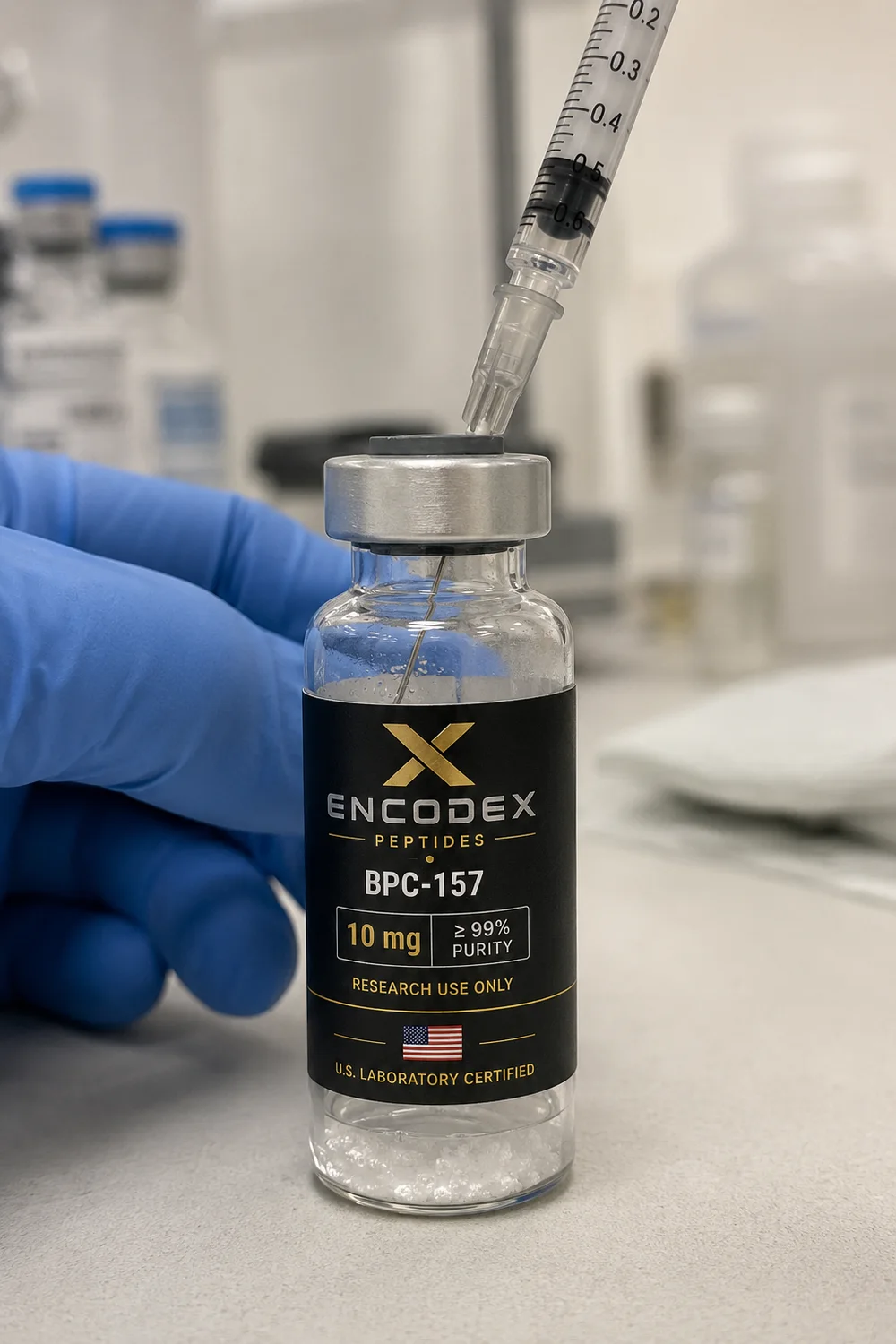
Laboratory handling guidance only. This describes standard practice for storing and preparing research reagents. It is not dosing guidance and carries no implication of human or veterinary use.
The Semaglutide molecule
Identifiers cross-checked against reference databases before publication. Where a value could not be verified from two independent sources, it is left out rather than estimated.
- · 1
- · 2 · Aib
- · 3
- · 4
- · 5
- · 6
- · 7
- · 8
- · 9
- · 10
- · 11
- · 12
- · 13
- · 14
- · 15
- · 16
- · 17
- · 18
- · 19
- · 20 · C18 diacid
- · 21
- · 22
- · 23
- · 24
- · 25
- · 26
- · 27
- · 28
- · 29
- · 30
- · 31
Positions are shown unlabelled because this chain contains non-standard or D-configured residues that have no valid one-letter code. The marked sites below are documented; the rest are drawn as positions only.
Documented modifications
- 2 Aib
- Aib, 2-aminoisobutyric acid. A non-standard residue that blocks the enzyme which would otherwise clear the peptide within minutes.
- 20 C18 diacid
- A fatty diacid on this side chain. It binds serum albumin reversibly, which is the design behind the multi-day half-life.
Sequence notes
His-Aib-Glu-Gly-Thr-Phe-Thr-Ser-Asp-Val-Ser-Ser-Tyr-Leu-Glu-Gly-Gln-Ala-Ala-Lys(AEEA-AEEA-γ-Glu-C18 diacid)-Glu-Phe-Ile-Ala-Trp-Leu-Val-Arg-Gly-Arg-Gly. Against native GLP-1: Ala8 becomes Aib, Lys34 becomes Arg, and the Lys26 side chain carries a C18 fatty diacid through a hydrophilic spacer.
Identifiers
- CAS number
- 910463-68-2
- Molecular formula
- C187H291N45O59
- Molecular weight
- 4113.58 g/mol
- Amino acid count
- 31
- Also known as
- NN9535
Sources: PubChem, DrugBank, ChEBI, UniProt and regulatory product labels.
How Semaglutide compares
The class comparison has its own article, written to be read on its own.
Selected published research
A starting point for the peer-reviewed literature, not a complete bibliography. Search any citation by title in PubMed or your institution's library to read the source.
- 01
Wilding JPH, et al., Once-weekly semaglutide in adults with overweight or obesity (STEP 1)
New England Journal of Medicine, 2021
The large randomised trial that established the compound's endpoint profile in a non-diabetic population.
- 02
Marso SP, et al., Semaglutide and cardiovascular outcomes in patients with type 2 diabetes (SUSTAIN-6)
New England Journal of Medicine, 2016
Cardiovascular outcome trial in a type 2 diabetes population.
- 03
Lincoff AM, et al., Semaglutide and cardiovascular outcomes in obesity without diabetes (SELECT)
New England Journal of Medicine, 2023
Outcome trial extending the cardiovascular question beyond diabetes.
- 04
Lau J, et al., Discovery of the once-weekly GLP-1 analogue semaglutide
Journal of Medicinal Chemistry, 2015
The medicinal-chemistry paper describing the structural modifications and how the half-life extension was engineered.
Citations are provided for scientific context. We are not affiliated with the authors, institutions or journals listed, and their publication implies no endorsement of this supplier or of any use of these compounds outside a laboratory.
Research questions about Semaglutide
What is semaglutide?
A synthetic, long-acting analogue of the incretin hormone GLP-1, modified for resistance to enzymatic degradation and extended circulation. Supplied here as a lyophilised research chemical for laboratory use only.
Why does semaglutide last so much longer than natural GLP-1?
Three modifications: an Aib substitution at position 8 that blocks DPP-4 cleavage, a lysine substitution at 34, and a C18 fatty-diacid chain that binds albumin reversibly. Together they take the half-life from roughly two minutes to roughly seven days.
How does semaglutide compare with retatrutide?
Semaglutide is a single GLP-1 agonist; retatrutide is a tri-agonist that also engages GIP and glucagon receptors. For isolating GLP-1 signalling specifically, semaglutide is the cleaner tool; for studying combined agonism, retatrutide is the reason the comparison exists.
What purity is your semaglutide?
Independently assayed by HPLC and mass spectrometry, released at ≥99%. Each production run is assayed on its own and released only if it passes.
How should it be stored?
Lyophilised at 2–8 °C, protected from light. Reconstituted solution stays refrigerated, with freeze-thaw cycles kept to a minimum.
What solvent should be used?
Bacteriostatic water for multi-draw work, the benzyl alcohol content inhibits bacterial growth across repeated withdrawals. We supply it alongside the peptides.
Is this the same as the branded pharmaceutical products?
No. This is a research chemical supplied to laboratories, not a pharmaceutical preparation, and it is not a substitute for any approved medicine. It is not for human or veterinary use.
Do you ship semaglutide worldwide?
Yes: insulated cold-chain packaging with tracking, discreetly labelled. Timing and payment options vary by destination and are shown at checkout.
How do you know the purity figure is real?
Every batch is assayed by an independent laboratory, by HPLC for purity and mass spectrometry for identity, and released only if it passes. No batch ships against another run's result.
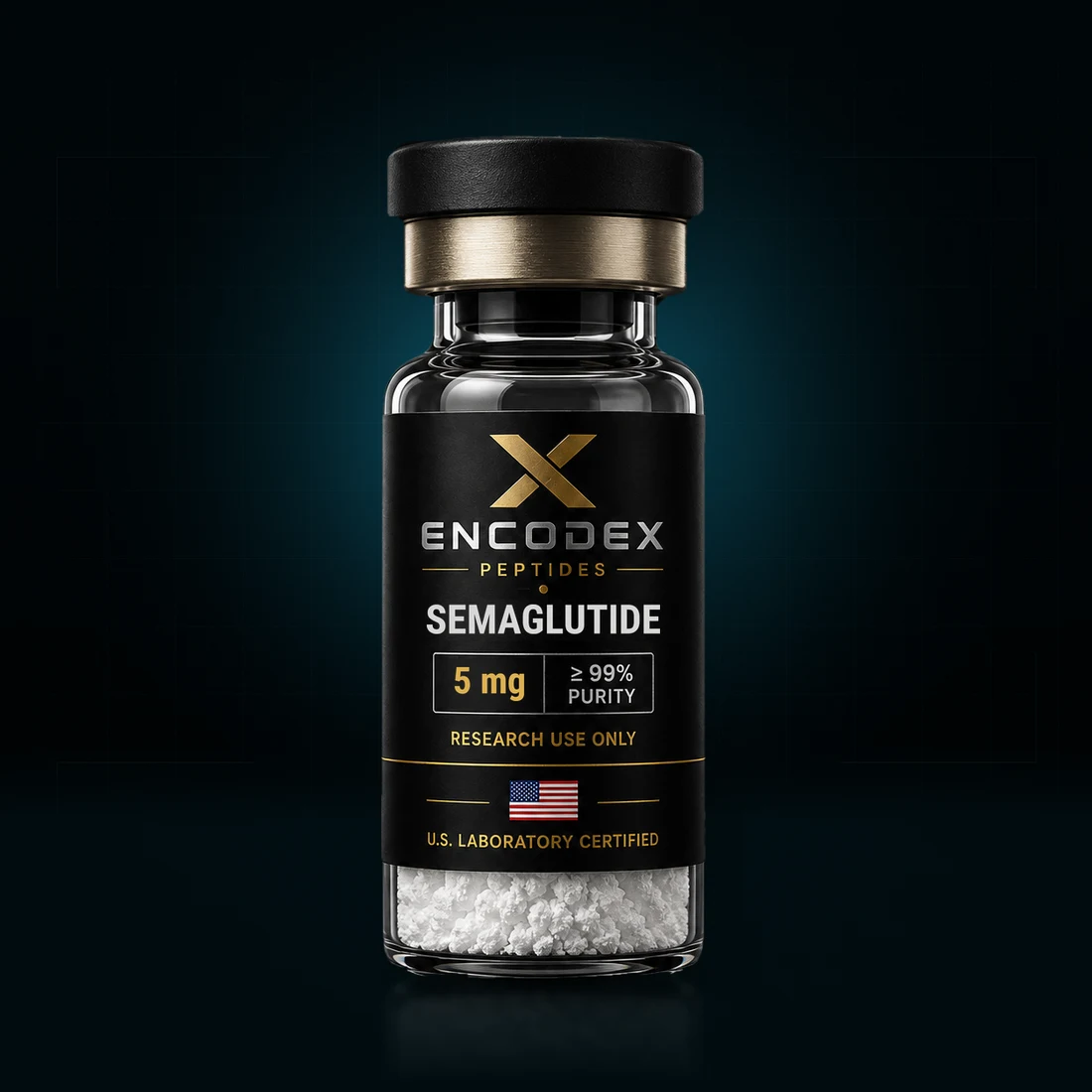
Source Semaglutide for your laboratory
Assayed at ≥99% purity, with the batch record published on the product page.