Selective GH secretagogue
Ipamorelin: the research picture
The selective secretagogue: GH release without the collateral hormones.
What is Ipamorelin?
Ipamorelin is a synthetic pentapeptide growth-hormone secretagogue that acts at the ghrelin receptor, GHSR-1a. It was characterised in the late 1990s and described in the literature as the first selective secretagogue of its class: "selective" meaning that, at the concentrations studied, it stimulated growth-hormone release without the accompanying elevations in ACTH, cortisol and prolactin that earlier secretagogues produced.
That selectivity is the entire research value of the molecule. Earlier compounds in the class stimulate GH but drag several other hormonal axes along with them, which makes it very hard to attribute an observed effect to growth hormone specifically. Ipamorelin narrows the variable.
It is a short-acting compound, reported half-life in the region of two hours, which produces a discrete GH pulse rather than sustained elevation. For studying the pulsatile character of GH signalling, that is a feature rather than a limitation.
Supplied lyophilised, independently assayed to ≥99% purity, with a per-lot certificate of analysis. Research use only.
Why it's studied
Selectivity narrows the variable
A secretagogue that raises GH without meaningfully moving cortisol and prolactin isolates the growth-hormone question from confounding endocrine noise.
Pulsatile release model
Its short duration produces a discrete, well-shaped pulse, useful when the research question concerns pulse characteristics rather than total exposure.
A distinct route from GHRH analogues
GHSR-1a and the GHRH receptor are separate entry points into the same axis. Comparing ipamorelin with tesamorelin separates the two pathways cleanly.
Well-characterised founding literature
The compound was described in a detailed pharmacology paper that remains the standard reference for its selectivity profile.
How Ipamorelin is understood to work
GHSR-1a agonism
Binds the growth-hormone secretagogue receptor 1a, the ghrelin receptor, on pituitary somatotrophs and in the hypothalamus, signalling through the Gq/phospholipase-C pathway and intracellular calcium release.
Selectivity profile
Published pharmacology reports GH release without the ACTH, cortisol and prolactin elevation seen with less selective secretagogues, which is the property the compound is known for.
Somatostatin interaction
GH release is set by the balance of GHRH and the inhibitory hormone somatostatin. Secretagogue research in this area examines how GHSR-1a agonism interacts with that inhibitory tone.
Short duration
A roughly two-hour half-life means exposure is brief and the resulting GH profile returns to baseline between administrations, the basis of pulse-oriented study designs.
Mechanistic descriptions summarise published laboratory research. They describe what the literature investigates, not effects in humans, and not guidance of any kind.
Storing and reconstituting Ipamorelin
Storage before reconstitution
Lyophilised at 2–8 °C, sealed and protected from light.
Reconstitution
Bacteriostatic water, added slowly against the vial wall with gentle swirling.
After reconstitution
Refrigerate at 2–8 °C, protect from light, and prepare volumes matched to the experiment.
Timing in study design
Endogenous GH secretion is pulsatile and circadian. Protocols normally fix the administration time and control for feeding state, since both influence the baseline the pulse is measured against.
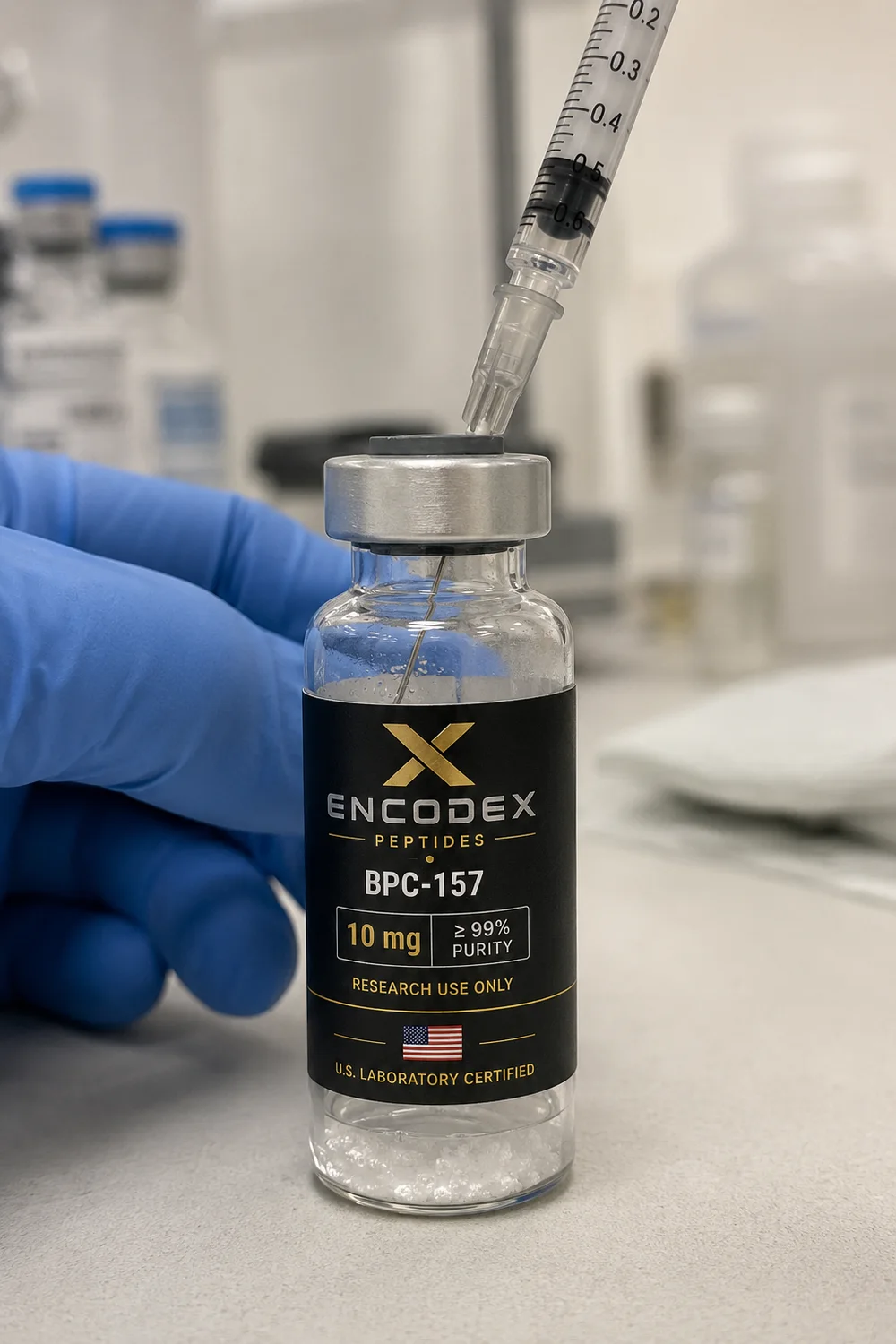
Laboratory handling guidance only. This describes standard practice for storing and preparing research reagents. It is not dosing guidance and carries no implication of human or veterinary use.
The Ipamorelin molecule
Identifiers cross-checked against reference databases before publication. Where a value could not be verified from two independent sources, it is left out rather than estimated.
- · 1 · Aib
- · 2
- · 3 · D-2-Nal
- · 4 · D-Phe
- · 5 · C-term NH₂
Positions are shown unlabelled because this chain contains non-standard or D-configured residues that have no valid one-letter code. The marked sites below are documented; the rest are drawn as positions only.
Documented modifications
- 1 Aib
- Aib, 2-aminoisobutyric acid. A non-standard residue that blocks the enzyme which would otherwise clear the peptide within minutes.
- 3 D-2-Nal
- A D-configured residue. Mirror-image geometry that natural enzymes are poor at recognising.
- 4 D-Phe
- A D-configured residue. Mirror-image geometry that natural enzymes are poor at recognising.
- 5 C-term NH₂
- The chain ends in an amide rather than a free acid, a common stabilising choice.
Sequence notes
Aib-His-D-2-Nal-D-Phe-Lys-NH₂. Aib is 2-aminoisobutyric acid, D-2-Nal is 3-(2-naphthyl)-D-alanine, and the C-terminal lysine is amidated. Three of the five residues are non-standard or D-configured, so there is no valid one-letter form.
Identifiers
- CAS number
- 170851-70-4
- Molecular formula
- C38H49N9O5
- Molecular weight
- 711.87 g/mol
- Amino acid count
- 5
- Also known as
- NNC 26-0161
Sources: PubChem, DrugBank, ChEBI, UniProt and regulatory product labels.
How Ipamorelin compares
The class comparison has its own article, written to be read on its own.
Selected published research
A starting point for the peer-reviewed literature, not a complete bibliography. Search any citation by title in PubMed or your institution's library to read the source.
- 01
Raun K, et al., Ipamorelin, the first selective growth hormone secretagogue
European Journal of Endocrinology, 1998
The founding characterisation paper, establishing the selectivity profile the compound is known for.
- 02
Gobburu JV, et al., Pharmacokinetic-pharmacodynamic modeling of ipamorelin, a growth hormone releasing peptide
Pharmaceutical Research, 1999
PK/PD modelling of the GH response.
- 03
Andersen NB, et al., The growth hormone secretagogue ipamorelin: effects on bone in model systems
Growth Hormone & IGF Research, 1999
Model-system work extending beyond the pituitary readout.
Citations are provided for scientific context. We are not affiliated with the authors, institutions or journals listed, and their publication implies no endorsement of this supplier or of any use of these compounds outside a laboratory.
Research questions about Ipamorelin
What is ipamorelin?
A synthetic pentapeptide growth-hormone secretagogue that acts at the ghrelin receptor GHSR-1a. Studied in GH-axis research; supplied for laboratory use only.
What makes ipamorelin "selective"?
Published pharmacology reports that it stimulates growth-hormone release without the ACTH, cortisol and prolactin elevations produced by earlier secretagogues, which is what allows the growth-hormone variable to be studied in relative isolation.
How does it compare with tesamorelin?
They act at different receptors, ipamorelin at GHSR-1a (the ghrelin receptor), tesamorelin at the GHRH receptor. Both enter the growth-hormone axis, by different routes, which is why they appear together in comparative study designs.
What is the half-life of ipamorelin?
Reported in the region of two hours, producing a discrete pulse rather than sustained exposure.
What purity is your ipamorelin?
Independently assayed by HPLC and mass spectrometry, released at ≥99%, certificate matched to the lot number on your vial.
Is ipamorelin approved for human use?
No. It is supplied as a research chemical for laboratory use only, not for human or veterinary use.
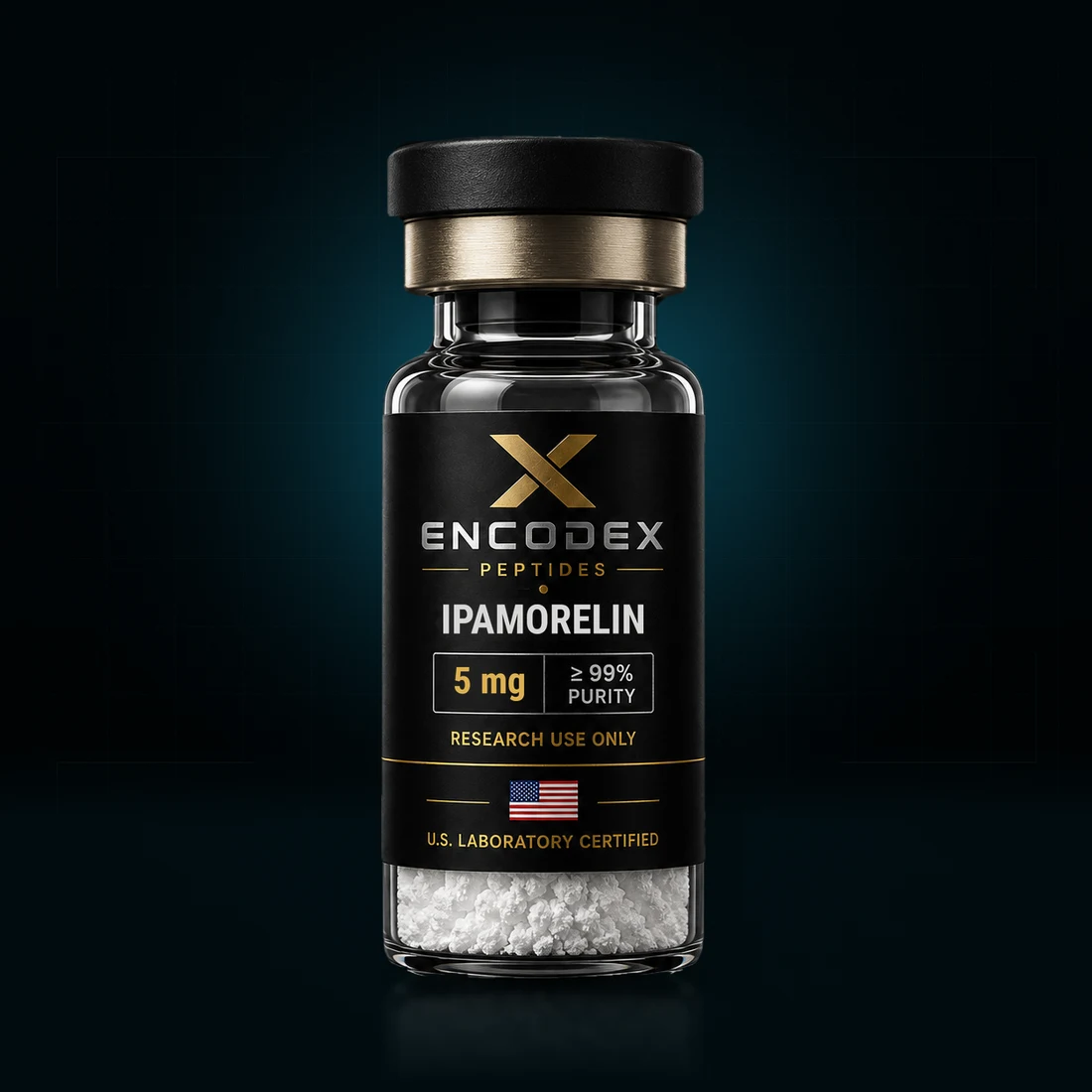
Source Ipamorelin for your laboratory
Assayed at ≥99% purity, with the batch record published on the product page.