Copper tripeptide-1
GHK-Cu: the research picture
Three amino acids, one copper ion, the most-studied peptide in matrix biology.
What is GHK-Cu?
GHK-Cu is a copper complex of the tripeptide glycyl-L-histidyl-L-lysine. The peptide occurs naturally in human plasma, where its concentration is reported to decline substantially with age. A observation that is itself a large part of why the molecule has been studied for five decades.
The copper ion is not incidental. GHK binds Cu(II) with high affinity, and the copper-bound complex is the form most of the literature examines: copper is a required cofactor for enzymes central to extracellular-matrix biology, including lysyl oxidase, which cross-links collagen and elastin. The peptide is best understood as a copper-delivery and copper-buffering molecule as much as a signalling one.
Research on GHK-Cu spans matrix remodelling, fibroblast behaviour, antioxidant response and, in more recent work, broad gene-expression profiling, where the peptide has been reported to shift expression across a large number of genes in cultured human cells. That transcriptomic breadth is the current frontier of the literature.
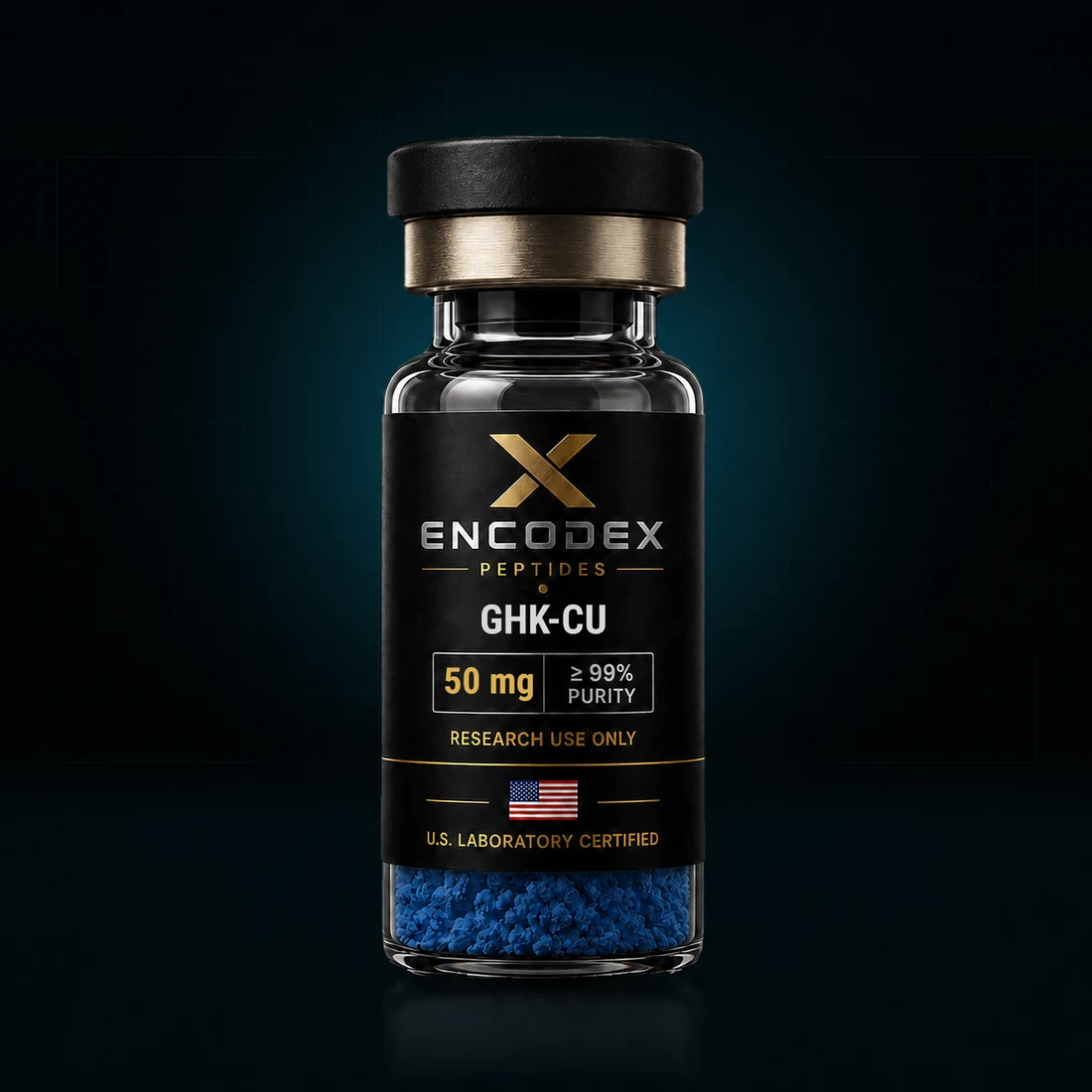
Supplied lyophilised, independently assayed to ≥99% purity, with a per-lot certificate of analysis. Research use only.
Why it's studied
Fifty years of literature
GHK was first isolated in the 1970s, which gives it one of the deepest and longest-running publication records of any peptide in the research market.
Copper biology in one molecule
Studying trace-metal cofactors usually means working with salts that have their own toxicity and distribution problems. A defined peptide-copper complex is a far cleaner instrument.
Matrix remodelling readouts
Collagen synthesis, metalloproteinase and TIMP expression, and glycosaminoglycan production are all established in-vitro readouts with published GHK-Cu data behind them.
Gene-expression breadth
Microarray work reporting expression changes across a large gene set has made GHK-Cu a subject of interest well beyond dermal research.
How GHK-Cu is understood to work
Copper coordination
The glycyl-histidyl-lysine sequence chelates Cu(II) with high affinity through the histidine imidazole and the peptide backbone nitrogens, the structural basis for its role in copper transport and buffering.
Matrix enzymes
Copper is a required cofactor for lysyl oxidase, the enzyme that cross-links collagen and elastin. The peptide is studied as a route for delivering that cofactor in a controlled, non-toxic form.
Fibroblast response
In-vitro work reports effects on collagen and glycosaminoglycan synthesis in fibroblast culture, and on the balance between matrix metalloproteinases and their tissue inhibitors.
Antioxidant pathways
Published work examines GHK-Cu in relation to superoxide dismutase activity and general antioxidant response, an area connected to but distinct from its matrix role.
Mechanistic descriptions summarise published laboratory research. They describe what the literature investigates, not effects in humans, and not guidance of any kind.
Storing and reconstituting GHK-Cu
Appearance
GHK-Cu is a deep blue powder and produces a distinctly blue solution. The colour comes from the copper coordination and is expected, not a defect.
Storage before reconstitution
Lyophilised at 2–8 °C, sealed and protected from light.
Reconstitution
Bacteriostatic water, added slowly against the vial wall with gentle swirling. Note that copper complexes are sensitive to chelating agents, avoid solvents or buffers containing EDTA unless the protocol calls for it deliberately.
After reconstitution
Refrigerate at 2–8 °C, protected from light. Copper peptide solutions are particularly light-sensitive.
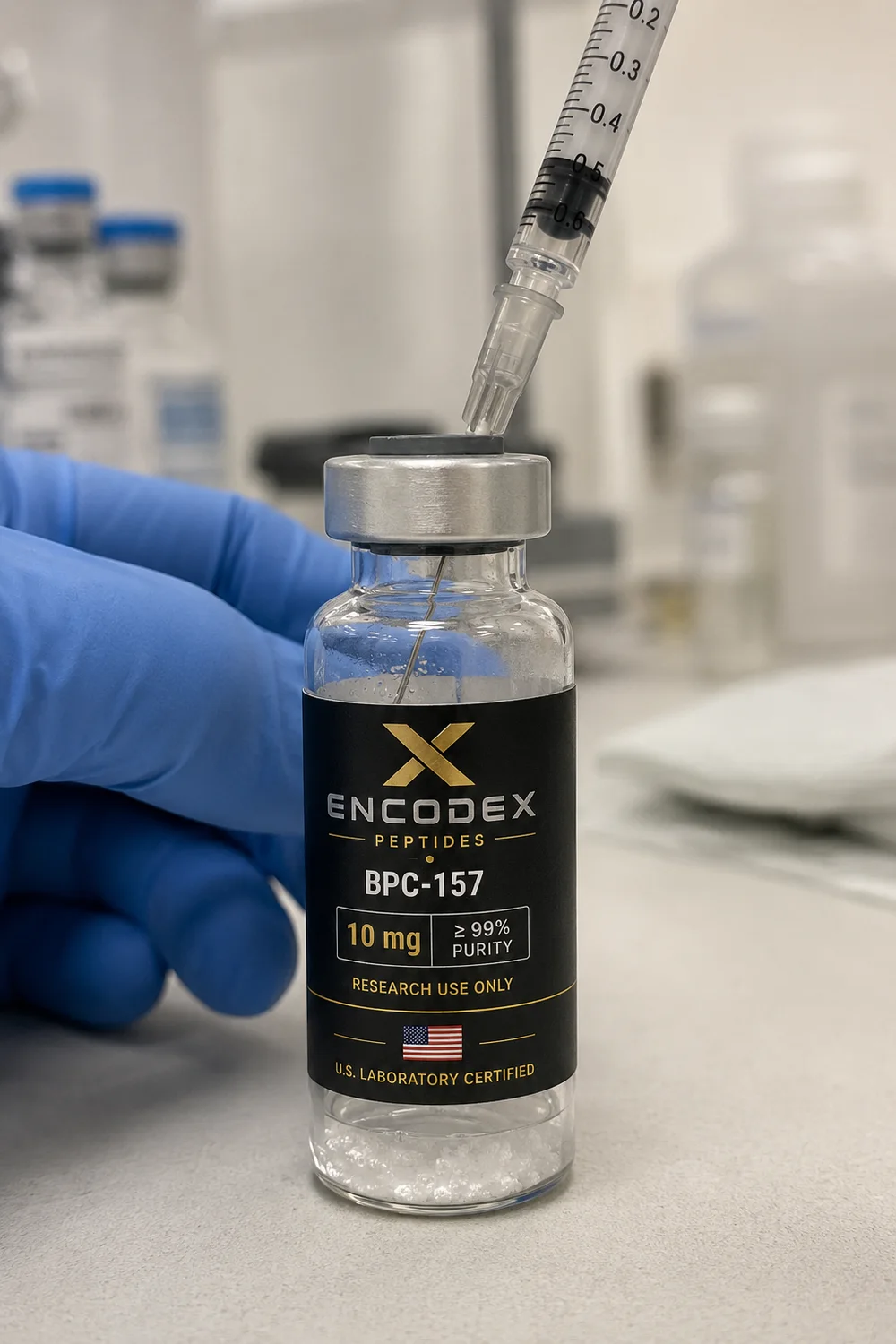
Laboratory handling guidance only. This describes standard practice for storing and preparing research reagents. It is not dosing guidance and carries no implication of human or veterinary use.
The GHK-Cu molecule
Identifiers cross-checked against reference databases before publication. Where a value could not be verified from two independent sources, it is left out rather than estimated.
- G 1 · Glycine
- H 2 · Histidine
- K 3 · Lysine
Sequence notes
Glycyl-L-histidyl-L-lysine, coordinated 1:1 with copper(II). The copper is a metal centre, not a covalent modification. Not to be confused with free GHK (CAS 49557-75-7), which contains no copper.
Identifiers
- CAS number
- 89030-95-5
- Molecular formula
- C14H22CuN6O4
- Molecular weight
- 401.91 g/mol
- Amino acid count
- 3
- Also known as
- Copper tripeptide-1 · Prezatide copper
Values are for the neutral 1:1 Cu(II) complex. Records for the cation and anion differ by one to two mass units.
Sources: PubChem, DrugBank, ChEBI, UniProt and regulatory product labels.
Selected published research
A starting point for the peer-reviewed literature, not a complete bibliography. Search any citation by title in PubMed or your institution's library to read the source.
- 01
Pickart L, Margolina A, Regenerative and protective actions of the GHK-Cu peptide in the light of the new gene data
International Journal of Molecular Sciences, 2018
Review integrating the classical matrix literature with gene-expression findings.
- 02
Pickart L: The human tri-peptide GHK and tissue remodeling
Journal of Biomaterials Science, Polymer Edition, 2008
Overview from the researcher who first isolated the peptide.
- 03
Maquart FX, et al., Stimulation of collagen synthesis in fibroblast cultures by the tripeptide-copper complex glycyl-L-histidyl-L-lysine-Cu2+
FEBS Letters, 1988
A foundational in-vitro fibroblast study.
- 04
Siméon A, et al., The tripeptide-copper complex GHK-Cu stimulates matrix metalloproteinase and tissue inhibitor expression
Journal of Investigative Dermatology, 1999
Examines the MMP/TIMP balance in dermal fibroblast culture.
Citations are provided for scientific context. We are not affiliated with the authors, institutions or journals listed, and their publication implies no endorsement of this supplier or of any use of these compounds outside a laboratory.
Research questions about GHK-Cu
What is GHK-Cu?
The copper(II) complex of the tripeptide glycyl-L-histidyl-L-lysine, a peptide that occurs naturally in human plasma. Studied in matrix-remodelling, fibroblast and antioxidant research; supplied for laboratory use only.
Why is it blue?
The colour is the copper coordination complex itself. A blue powder and blue solution are exactly what correctly synthesised GHK-Cu looks like.
What is the difference between GHK and GHK-Cu?
GHK is the bare tripeptide; GHK-Cu is that peptide with a bound copper(II) ion. Most published research uses the copper complex, since the copper is central to the proposed mechanisms.
What purity is your GHK-Cu?
Independently assayed by HPLC and mass spectrometry, released at ≥99%, certificate matched to the lot on your vial.
How should GHK-Cu be stored?
Lyophilised at 2–8 °C protected from light. Reconstituted solution refrigerated and shielded from light, copper peptide solutions are notably light-sensitive.
Can it be combined with other peptides in one protocol?
It appears alongside KPV, BPC-157 and TB-500 in our KLOW blend for protocols that call for the combination from a single vial. As always, this is supplied for laboratory research only.
Source GHK-Cu for your laboratory
Assayed at ≥99% purity, with the batch record published on the product page.